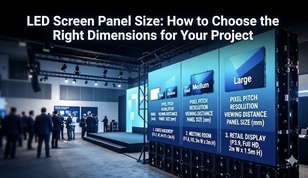
Understanding how individual LED display modules integrate into structural cabinets allows system integrators, AV consultants, and commercial buyers to eliminate alignment errors, prevent awkward media scaling, and optimize power delivery.
This technical guide examines standard panel specifications, aspect ratio calculations, pixel pitch dynamics, application-specific deployment strategies, and key structural trade-offs to help you specify the ideal display dimensions for your next installation.
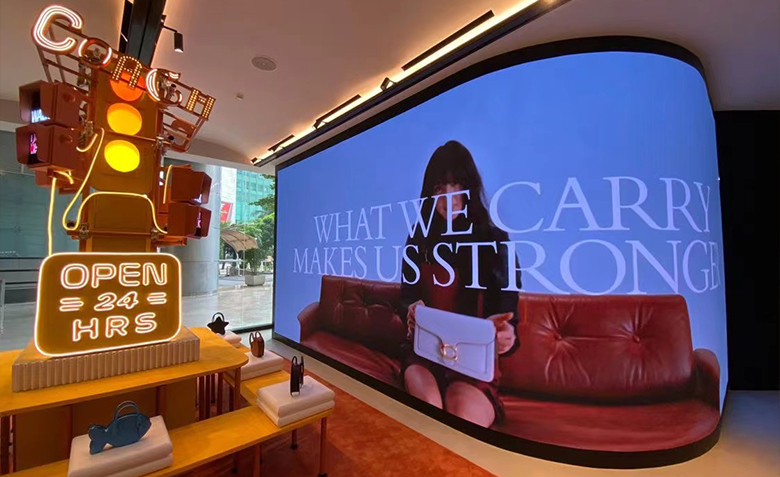
In LED display engineering, panel sizing extends beyond fitting physical wall dimensions. The structural footprint of a cabinet establishes the physical foundation for pixel density, thermal dissipation, structural weight load, and electrical distribution.
Optical Integrity: Physical panel dimensions dictate how accurately you can construct native target resolutions (such as Full HD 1080p, 4K, or 8K) without distorting source media through hardware scaling.
Structural Safety: Panel size governs wind-load resistance and total dead weight. Larger panels reduce mechanical connection points, while smaller modular panels offer superior wind-load resistance on outdoor truss systems.
Budget Optimization: Standardizing cabinet dimensions lowers manufacturing costs, streamlines shipping logistics, and simplifies long-term spare parts inventory management.
Specifying an LED display wall requires a clear distinction between the two core building blocks of a screen array: the LED Module and the LED Cabinet (also referred to as a panel or tile).
An LED Module is the foundational pixel matrix component. It consists of Surface-Mounted Device (SMD) or Chip-on-Board (COB) LEDs, driving ICs, a printed circuit board (PCB), and a protective mask. Modules deliver visual output but lack self-supporting structural elements.
An LED Cabinet is the structural chassis that houses multiple LED modules alongside power supply units (PSUs), receiving cards, internal wiring, and cooling mechanisms. As a premier manufacturer, Vision LED Pro engineers high-precision die-cast aluminum and steel cabinets designed to latch together seamlessly, ensuring smooth visual continuity across massive display walls.
Once module dimensions are selected, they are configured into structural cabinets to build the complete screen framework.
An LED cabinet serves as the self-supporting enclosure for modules. It incorporates alignment pins, quick-locking mechanisms, power supplies, and signal receivers. Manufacturing tolerances of the cabinet frame directly determine whether a completed display achieves a seamless appearance or exhibits visible vertical seams.
In event production, rapid rigging, structural rigidity, and low overall weight are critical operational factors:
500mm x 500mm: The global benchmark for event staging. Housing four 250x250mm modules, it allows technicians to build curved, staggered, or creative square screen configurations easily.
500mm x 1000mm: Designed to accelerate installation times on large stage backdrops. By covering twice the vertical area, it reduces mechanical locking points and rigging time by up to 50%.
Fixed outdoor displays require heavy-duty weatherproofing, passive thermal management, and structural steel integration:
960mm x 960mm: The universal standard for commercial billboards, accommodating eighteen 320x160mm modules in a 6x3 grid.
1000mm x 1000mm: Preferred in metric-standard architectural markets to simplify structural steel engineering and spatial planning.
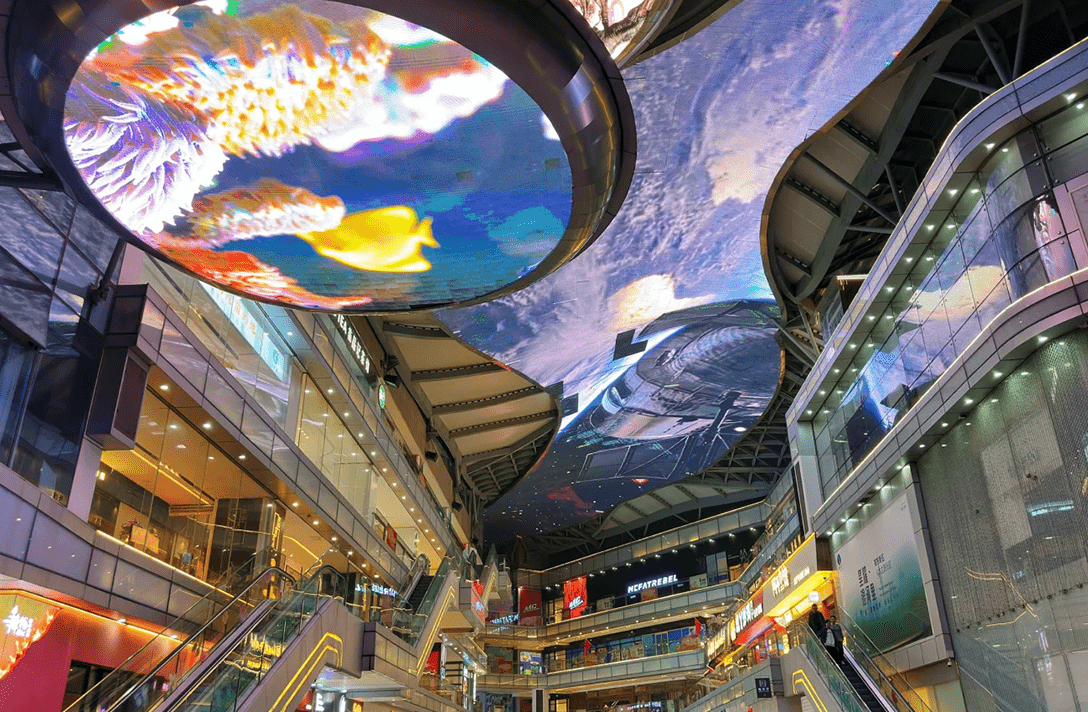
High-definition indoor environments require matching cabinet dimensions to standard media aspect ratios:
600mm x 337.5mm (16:9 Aspect Ratio): Engineered so that building an equal horizontal and vertical cabinet matrix (e.g., 4x4, 8x8) automatically produces a native 16:9 aspect ratio without video scaling artifacts.
640mm x 480mm (4:3 Aspect Ratio): Legacy standard for indoor video walls utilizing 320x160mm modules in a 2x3 module configuration.
Achieving native Full HD (1920 × 1080) or 4K UHD (3840 × 2160) resolution without hardware scaling requires matching the cabinet grid directly to the target pixel array:
| Resolution Target | Pixel Pitch | Cabinet Size | Matrix Configuration | Total Physical Dimensions | Total Pixels |
|---|---|---|---|---|---|
| Full HD (1080p) | P1.25mm | 600 x 337.5mm | 4 Wide x 4 High | 2.4m x 1.35m | 1920 × 1080 |
| Full HD (1080p) | P1.5625mm | 600 x 337.5mm | 5 Wide x 5 High | 3.0m x 1.6875m | 1920 × 1080 |
| 4K UHD (2160p) | P1.25mm | 600 x 337.5mm | 8 Wide x 8 High | 4.8m x 2.7m | 3840 × 2160 |
| Full HD (1080p) | P2.5mm | 500 x 500mm | 10 Wide x 6 High | 5.0m x 3.0m | 2000 × 1200 |
Different operational environments dictate specific cabinet form factors, structural materials, and ingress protection ratings.
VisionLedPro, your ultimate destination for advanced LED display products, engineers application-tailored display hardware across all key industrial verticals:
Event production environments prioritize rapid rigging, low cabinet weight, and structural flexibility:
Recommended Form Factors: 500x500mm and 500x1000mm die-cast aluminum Rental LED Display cabinets.
Engineering Priority: Combining 500x500mm and 500x1000mm panels within a single frame provides rigging crews maximum flexibility to assemble custom stage backdrops, creative hanging columns, and curved video arrays.
Architectural indoor environments require high pixel density, silent passive cooling, and ultra-thin profiles:
Recommended Form Factors: 600x337.5mm or 640x480mm fine-pitch cabinets featuring Small Pixel Pitch LED Display and Indoor LED Display architectures.
Engineering Priority: Utilizing ultra-thin cabinet frames enables surface-mount wall installations that comply with public safety projection guidelines without requiring deep wall recesses.
The Outdoor LED Screen is an advanced display solution engineered to withstand harsh weather conditions, extreme ambient sunlight, and continuous 24/7 operation:
Recommended Form Factors: 960x960mm or 1000x1000mm profile aluminum or steel cabinets (P3.91mm to P10mm) for Outdoor LED Display and Fixed LED Display installations.
Engineering Priority: Modular panel configurations with IP65+ ingress protection ratings ensure reliable 24/7 continuous operation in heavy rain, dust storms, and extreme temperatures.
For specialized creative projects requiring high visual transparency or unique structural forms, alternative panel architectures offer distinctive advantages:
Transparent LED Display: Ideal for glass curtain walls and luxury retail storefronts, offering high light transmittance without blocking natural light or indoor visibility.
Creative LED Display: Custom flexible modules, spherical display panels, and right-angle corner cabinets designed to conform to complex architectural structures.
Choosing physical panel dimensions involves evaluating key trade-offs between hardware cost, installation labor, and long-term maintenance access.
Cabinet dimensions directly influence labor efficiency during installation:
Larger Cabinets (500x1000mm / 960x960mm): Cover more surface area per tile, reducing structural connection points, signal cables, and installation time by up to 40%. However, they typically require two technicians or mechanical hoists to align safely.
Smaller Cabinets (500x500mm): Allow a single technician to carry and lock tiles into place, making them ideal for restricted-access spaces. However, they increase the total number of structural latches, power jumpers, and signal connections required across the video wall.
Maintenance access dictates how display mounting structures are designed and integrated into a venue:
Front-Serviceable Cabinets: Modules attach magnetically and are extracted from the front using specialized vacuum tools. This eliminates the need for a rear maintenance corridor, enabling direct wall-mounted installations.
Rear-Serviceable Cabinets: Modules are unbolted from behind the chassis. While these cabinets carry lower initial hardware costs, they require leaving a dedicated rear service corridor (typically 600mm to 800mm deep), increasing overall venue footprint requirements.
The 500x500mm die-cast aluminum cabinet is the industry standard for rental staging, while the 960x960mm cabinet leads fixed outdoor commercial billboard installations.
Divide your target screen width and height by the individual cabinet dimensions, maintaining a horizontal-to-vertical panel ratio of approximately 1.77:1 (such as 16 panels wide by 9 panels high for square tiles).
An LED module is the individual circuit board component containing the LED pixels, whereas an LED panel (or cabinet) is the structural frame that houses multiple modules, power supplies, and control cards.
Yes, LED display arrays can be fully customized to virtually any width, height, or architectural curve by combining standardized modular cabinets or engineering custom frame structures.
Choosing the correct LED screen panel size requires a balanced assessment of pixel pitch, viewing distance, aspect ratio, and structural maintenance. Selecting standardized panel dimensions allows integrators to optimize visual performance while minimizing procurement and installation costs.
As a factory-direct manufacturer, Vision LED Pro delivers precision-engineered display panels, strict quality compliance, and complete technical support for global projects. Contact Vision LED Pro today to consult with an engineer and receive a tailored specification for your installation.



 Tel: +86-134 2792 1400
 Email: led@visionledpro.com

Address: Second Industrial Park,No. 28, Xintang Road, Fuhai Street, Baoan District, Shenzhen,CHINA
Copyright © 2020 Shenzhen Vision Pro Electronic Co., Ltd All rights reserved.

By continuing to use the site you agree to our privacy policy Terms and Conditions.