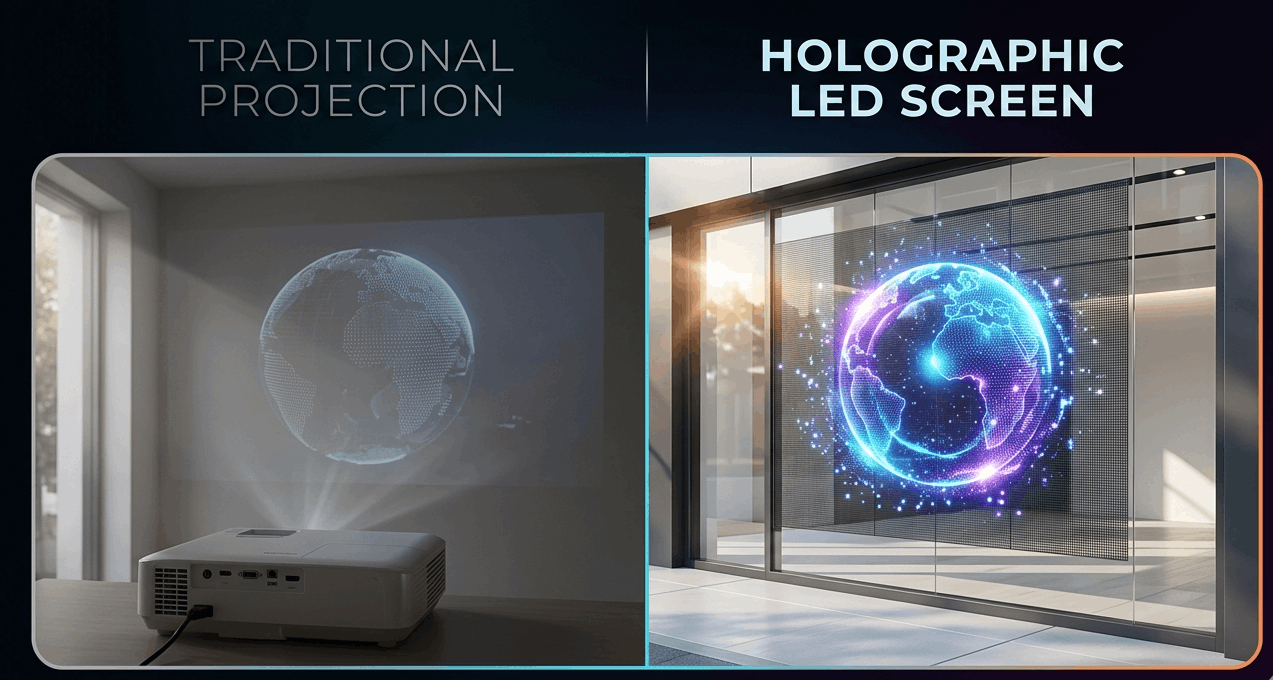
Investing in a Holographic LED screen offers a higher return on investment (ROI) compared to traditional projection or LCD displays. While the initial cost may be higher, the combination of daylight visibility, lower energy consumption, and modular durability significantly reduces the total cost of ownership over a five-year period.
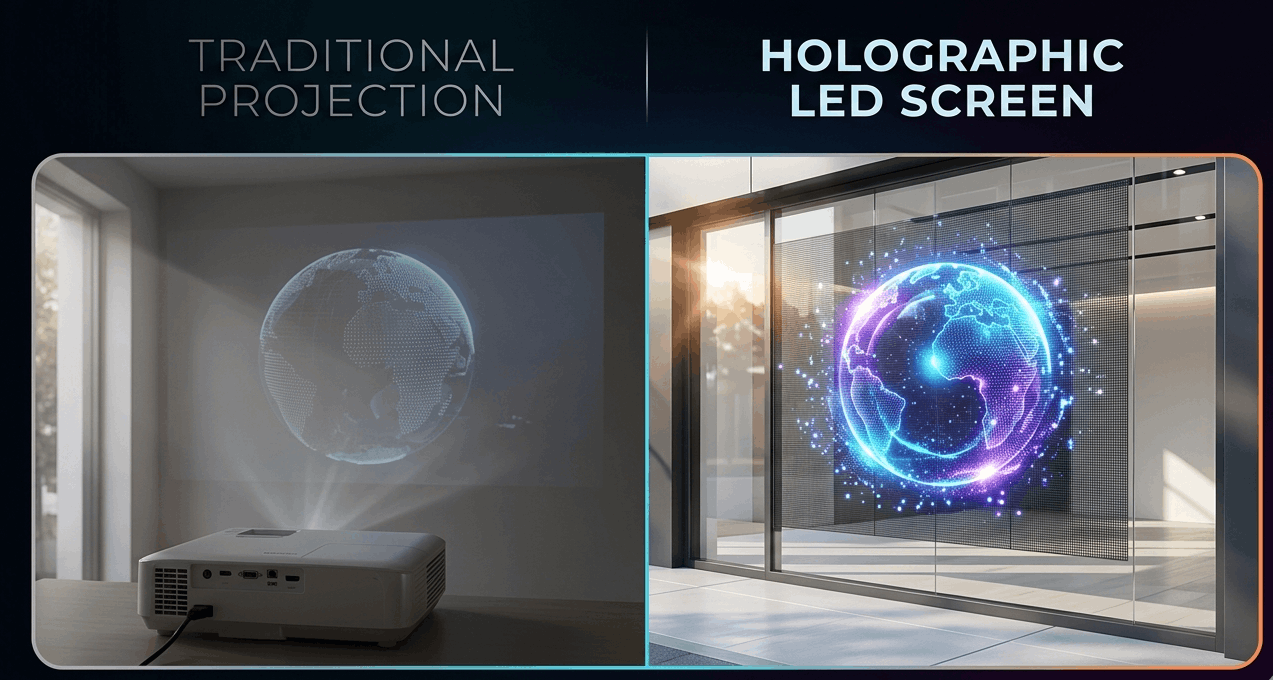
In commercial environments, visibility equals foot traffic. Traditional projection systems struggle in bright retail settings, often appearing washed out during daylight hours. A Holographic LED screen provides a high-brightness output of up to 5000 nits.
This high luminosity ensures that 3D content remains vivid even in direct sunlight. For retail windows, this means your brand message stays active and effective 24 hours a day. You no longer lose potential customers during the brightest parts of the afternoon.
Brightness also affects the quality of the holographic illusion. High contrast between the illuminated pixels and the transparent background deepens the 3D effect. This superior visual performance directly correlates to higher customer engagement and brand recall.
A Holographic LED screen is engineered for the rigors of commercial use. Unlike consumer-grade displays, these screens utilize industrial SMD LEDs with a rated lifespan of 100,000 hours. This equates to over 11 years of continuous operation.
The physical structure is made of lightweight, aviation-grade aluminum. This material provides excellent heat dissipation without the need for noisy cooling fans. Reducing heat is the most effective way to prevent LED decay and ensure color consistency over time.
Furthermore, these screens are highly resistant to environmental factors. The hollow design allows for natural airflow, which prevents moisture buildup behind the glass curtain wall. This stability is a critical factor for engineers who require reliable hardware for large-scale infrastructure projects.
The most significant hidden value of these displays lies in their modular repairability. Before analyzing the long-term expenses, it is helpful to understand what is a holographic LED screen and how its strip-based architecture functions. In a standard LCD or projection setup, a single major failure often requires the replacement of the entire unit or an expensive projector bulb.
With a Holographic LED system, the screen is composed of individual strips and modules. If a single pixel or strip fails, a technician can replace just that specific component in minutes. This avoids the high cost of full-unit replacement and minimizes system downtime.
This "plug-and-play" repairability ensures that the display remains flawless for its entire lifecycle. It also eliminates the need for highly specialized repair crews, further reducing operational expenses.
| Maintenance Factor | Traditional Projector | Holographic LED Screen |
|---|---|---|
| Light Source Life | 5,000 - 20,000 Hours | 100,000 Hours |
| Cooling Requirements | High (Internal Fans) | Low (Natural Convection) |
| Repair Unit | Entire Unit / Bulb | Individual LED Strip |
| Downtime | High (Factory Repair) | Low (On-site Strip Swap) |
| Consumables | Filters and Bulbs | None |
A Holographic LED screen is an energy-efficient solution. Because the screen utilizes the "black-out" principle for transparency, black pixels do not consume power. In a typical 3D holographic video, up to 70 percent of the screen may be "off" at any given time.
This results in a 30 to 50 percent reduction in electricity costs compared to standard solid LED walls. Over several years, these energy savings can offset a large portion of the initial hardware investment.
From a marketing perspective, the ROI is driven by the "Stop-and-Stare" effect. Data shows that 3D holographic displays can increase pedestrian dwell time by over 400 percent. This massive increase in attention translates directly into higher conversion rates for retail and exhibition spaces.
Choosing a Holographic LED screen is a strategic financial decision. It combines the visual impact of a futuristic 3D display with the reliability of industrial-grade hardware. It is the ideal solution for businesses looking to minimize long-term costs while maximizing visual impact.
VisionLedPro provides comprehensive ROI analysis and technical support for global installations. Our engineering team ensures that your display is optimized for both performance and energy efficiency. Contact us today to discuss your project specifications and receive a detailed quote.



 Tel: +86-134 2792 1400
 Email: led@visionledpro.com

Address: Second Industrial Park,No. 28, Xintang Road, Fuhai Street, Baoan District, Shenzhen,CHINA
Copyright © 2020 Shenzhen Vision Pro Electronic Co., Ltd All rights reserved.

By continuing to use the site you agree to our privacy policy Terms and Conditions.